Learn why DarkSkiez Observatories is different than others – Experience professional-grade stability for your most important cosmos targets.
Table of Contents
Last month, something took out our aerial fiber at 11 p.m. A line strung in open air along the electric poles is only as safe as the weather – and whatever happens to be driving past. The moment that carrier went dark, our buried underground line picked up every session on site. Nobody imaging remotely noticed, because there was nothing to notice: no dropped exposure, no reset mount, no 2 a.m. apology email.
That non-event is the entire point of this post. If you’ve booked time on a remote scope and wondered what’s actually standing between your 12-hour integration and a lost night, here’s the honest answer: two fibers, zero wireless, ISP-grade gear, power we barely have to think about anymore – an automated fallback path that keeps the scopes collecting even if everything else quits – and two support teams covering every hour of the night.
The Site: Rural, But Not Remote-Grade-Neglectful
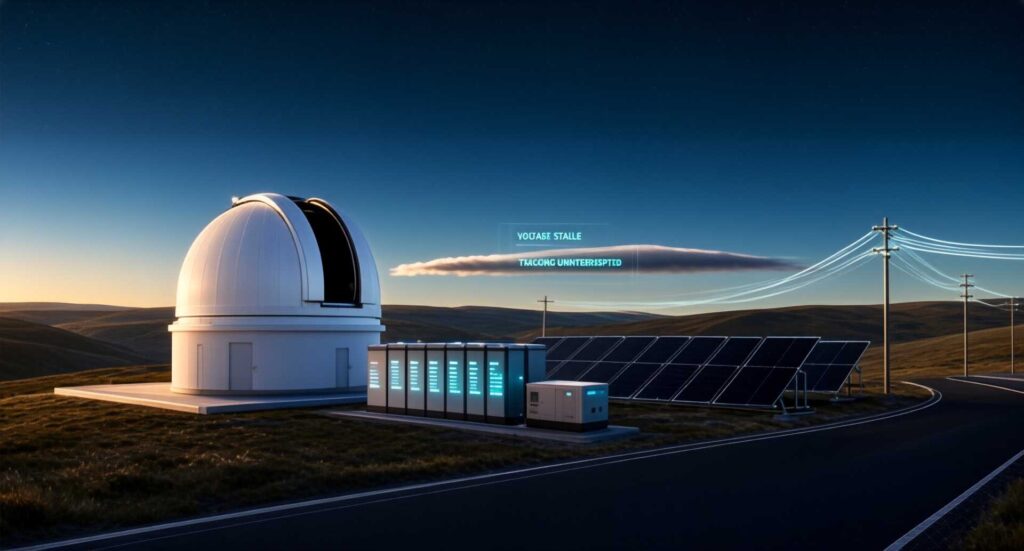
There’s a difference between “rural” and “improvised.” Our site sits at the end of a blacktop road with a new three-phase utility feed – dedicated, clean, and stable enough that power is now the least interesting part of our stack. On top of that baseline we run a solar array with a large battery bank for ride-through and backup generators for anything long. The result: brownouts don’t reach the telescopes, voltage sags get logged before they get to be events, and a grid hiccup never resets a tracking session.
The climate works in our favor too. This is stable weather with slow changes – temperatures drift rather than spike, wind stays moderate, and the air is clean. The one recurring character is the hills: clouds sometimes roll up over them on their own schedule. Because the front moves slowly, we see it coming early enough to hold or reschedule a session cleanly instead of burning an integration on a closing sky.
The Connection: Two Fibers, Zero Wi-Fi
Our connectivity architecture is deliberately boring, which is what you want in infrastructure:
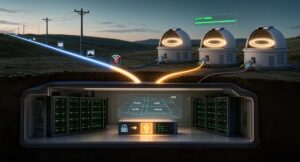
- Redundant fiber, physically separated. One line runs underground; the other rides the electric poles in open air. Buried lines get threatened by excavation and ground weather; aerial lines get threatened by wind and hardware on the poles. A single event rarely takes out both, and automatic failover hands traffic to the surviving path in seconds – well inside the tolerance of anything we run remotely.
- No Wi-Fi anywhere in the imaging chain. Every telescope booth is hardwired by Ethernet into the backbone rack. A wireless hop introduces exactly the latency spikes and packet loss that quietly ruin remote guiding, so we don’t give it a chance to exist.
- ISP-grade equipment, not consumer gear. The rack runs carrier-class networking hardware built for uptime, configured for high availability with automatic failover. Firewalls sit between the public internet and everything else, and remote access plus our monitoring live in a DMZ – an isolated zone – every booth on its own VLan – so the telescope network itself is segmented behind it. Your session, our monitoring and the scopes don’t share an address space.
- We watch latency, not just link status. A line can be “up” at triple the normal round-trip time and still be a problem for command traffic. Our heartbeat monitors flag degradation before a user ever feels it.
One architectural detail matters most for power users: the tracking and guiding loops live inside each telescope and never cross our network. Your exposure timing is not hostage to a congested link 40 miles away. What traverses the redundant fiber is command/control, status, and finished frames – smaller, more tolerant traffic.
The Telescopes: Enclosed Smart Scopes, Climate Managed
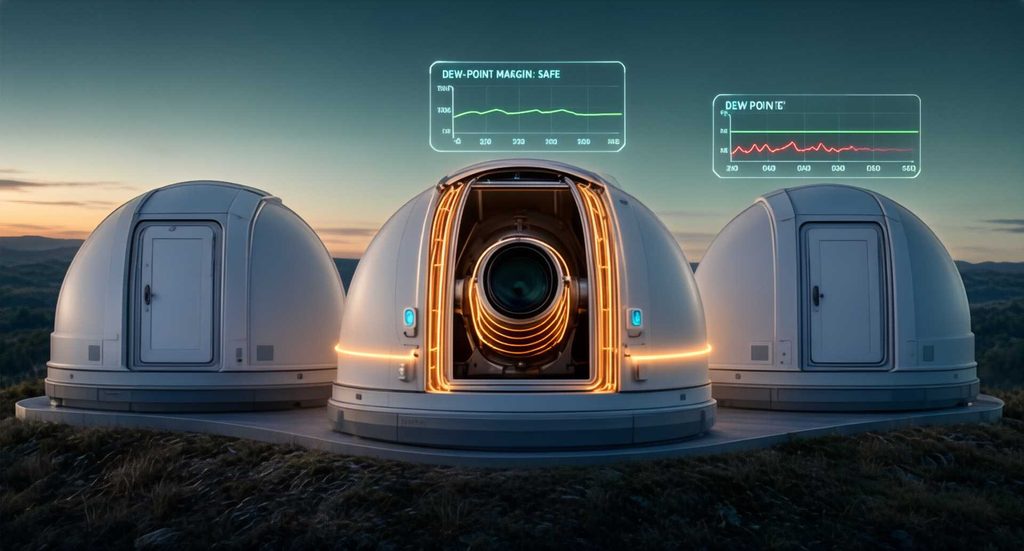
All of our telescopes are enclosed smart telescopes – fully sealed units, some with integrated heaters – and that changes the maintenance story completely compared to open-air rigs:
- Sealed against the environment. Optics sit behind a closed door in air that’s already clean, so dust management is a scheduled check rather than a nightly battle.
- Condensation is a solved problem, not an anxiety. Integrated heaters and internal humidity sensing keep the optics ahead of the dew point; we log dew-point trend and heater status at the start of every session and any enclosure trending toward fog gets flagged before there’s a droplet on your image.
- Stable weather means stable focus. With temperatures changing slowly (not like in a high-desert environment), thermal drift is predictable and mild – focus stays put across long integrations rather than creeping out of registration in hour three.
When the Rack Goes Down: The App Is the Last Line of Defense
Redundancy has to work at every layer, not just the cable level.
- Virtual machines behind a load balancer. Our application software runs as virtual machines on redundant servers, fronted by a load balancer. A single VM crashing – or a planned software update rolling out – is absorbed: traffic simply rides to a healthy VM. “One server at a time” failures don’t reach you, because there is no single server.
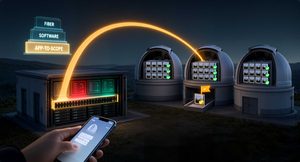
- If the whole application tier goes dark, the scopes don’t stop. This is the deepest layer of the design, and it’s what lets us say worst case is delay, not loss. Every smart telescope carries its own local storage and processing. Should something take out the entire server stack – an event we engineer for rather than hope to avoid – the smartphone app can still talk directly to the telescopes: point them, schedule exposures, start collecting. Data lands on each scope’s internal storage and stays safe there until infrastructure returns.
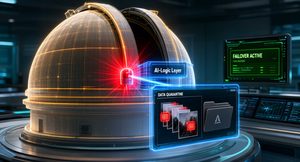
- Then everything reconciles. Once the servers are back, locally collected data syncs up through the normal pipeline – checksums verified, flagged frames quarantined. Nothing in your integration queue is lost to a site-side failure.
That’s the honest hierarchy: fiber redundancy handles the common events, virtualization and load balancing handle the software events, and app-to-scope failover with local storage turns “everything broke at 3 a.m.” from a catastrophe into an inconvenience.
When Something Does Break
Even boring infrastructure has a runbook, and every runbook ends with verification before the scope returns to service:
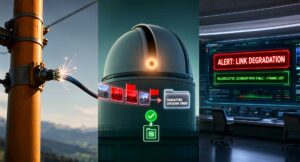
- Detect. Alerts page both desks — the on-site crew and Zurich — on any heartbeat miss, link degradation or threshold breach; power quality, humidity trends and motor behavior included.
- Stabilize. An affected session is either safely completed (if data is clean) or paused mid-sub-exposure so no partial frame enters the queue.
- Diagnose from logs first. Our two recent scares were caught this way: one aerial-fiber event where the buried line carried everything without a dropped frame and one enclosure whose internal humidity trend told us about a heater problem hours before it could have fogged an optic.
- Fix and verify. Hardware gets addressed on our next physical visit when it isn’t a remote reset, followed by a tracking test, a short verification exposure and – after any server-side event – confirmation that local storage has fully synced before the session resumes.
And we quarantine rather than hope: any sub-exposure flagged for focus drift, tracking anomaly, or failed transfer checksum is tagged and pulled from your stack automatically. You get clean data or you get told – never a poisoned stack that costs an evening to diagnose.
Two Teams, One Night: Support Across Two Time Zones
Redundancy isn’t only about hardware. The last layer is human.
- On-site, every night. A member of the on-site team is at the mountain all night – someone who can be at a scope within minutes when a problem needs hands instead of a remote command.
- Zurich, on the other side of the world. Our remote support desk runs out of Zurich, Switzerland. Because of the time difference, when it’s late night and early morning at the mountain – exactly the hours when condensation risk peaks and fatigue sets in – it’s mid-morning to midday in Zurich. In that stretch you effectively get two fully staffed teams: on-site hands for physical interventions and a rested engineering desk running full log analysis, network diagnostics and firmware work.
- A 4 a.m. page is not a solo job. When an alert fires in the middle of the night it reaches both desks at once: someone boots up to walk to the enclosure while someone in Zurich is already deep in the logs. Escalation doesn’t wait until morning to be thought about – it’s already being worked on.
- Handovers are written, not remembered. When Zurich hands the night back to the site’s day shift, a status summary travels with it: open items, trends under watch, verifications scheduled. Nothing is lost in transition.
For power users running long integrations, this means the hours most sites call “bad luck hours” are actually when our engineering coverage is thickest.
What This Means for Your Session
For the targets that actually stress-test all of this – 10+ hour integrations on M33, multi-night narrowband programs on faint nebulae, wide-field mosaics where every panel has to hold up – stability is the product. The optics get you there; it’s the unglamorous infrastructure behind them that decides whether hour nine of your integration is data or a lesson in rural meteorology.
- 2× fiber paths, physically separated, with automatic failover
- 0 wireless hops in the imaging chain
- ISP-grade rack with firewall and DMZ isolation
- Three-phase utility + solar/battery + generator – power that stays out of the conversation
- Enclosed smart scopes with integrated dew management, local storage, local battery and local guiding
- VMs behind a load balancer, with smartphone-app failover that keeps scopes collecting even if the whole server tier quits
- 24/7 human redundancy – on-site night crew plus a Zurich remote desk covering the late-night hours hardest
We built this site to be boring on purpose: no surprises at 2 a.m., no mystery soft stars, no integration lost to a line cut. When you point one of our telescopes at your most important target, the engineering underneath should be so reliable it never enters your thoughts.
Experience professional-grade stability for your most important targets.
Are you ready to start with us ? 👉 getSTARTed !